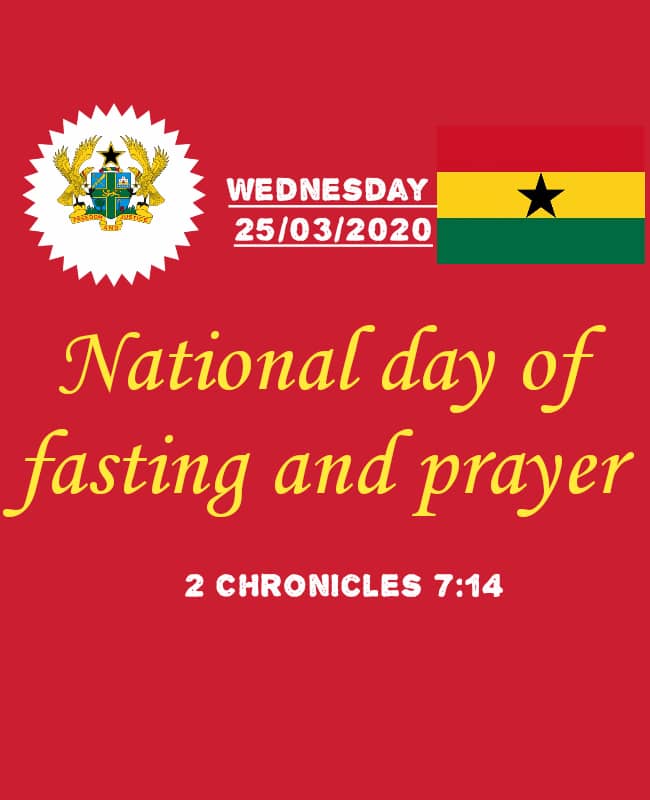
On the 21st March 2020, the President of the Republic of Ghana, His Excellency Nana Addo Dankwa Akufo-Addo addressed the nation in a televised broadcast updating us on Covid-19 and government’s measures in dealing with the disease. The transcript of the address can be read here. Among many things the President spoke about, he declared today the 25th March 2020 as a National Day of Prayer And Fasting.
The theme text for this national spiritual exercise is 2 Chronicles 7:14 which clearly sets forth certain truths. It is a call to prayer. And this call to prayer is a call directed at God’s people. It means God has a people. It also speaks of humbling ourselves which clearly speaks of our dependence and reliance on God. We pray because we trust God. We pray because we are weak. We pray because we have limitations as humans. Most importantly, we pray because God commands we pray (Luke 18:1). The text also speaks of turning from our wicked ways. Here is an element of repentance. We must come to God in humility confessing and turning away from our sins. And finally, there is an assurance of answered prayer: “then will I hear from heaven, and will forgive their sin, and will heal their land” This is a promise we can lay hold onto as we approach God in prayer. And may our seeking of the face of God not end only today. May it continue the rest of our lives
As the people of God and as Christians, the place of prayer cannot be overemphasized for Scripture in many places calls on believers to pray and bring their petitions before God (.Luke 18:1; Psalm 50:15; 1 Thessalonian 5:17 ). If you are a believer, prayer is not optional. You have to pray. As we join together as a nation in this important exercise, I want to share briefly on What is Prayer hoping it helps to guide us into an effectual prayer
What Is Prayer?
I will turn to the Westminster Shorter Catechism Question 98 to answer the question
Prayer is an offering up of our desires unto God, for things agreeable to his will, in the name of Christ, with confession of our sins, and thankful acknowledgement of his mercies.
This definition clearly points us to what prayer is.
Our Prayer must be to God.
Prayer is an offering up of our desires unto God
The first point the definition brings out is that our prayer is to God. In our African setting, it is said: “if you want to speak to God, speak into the air.” This on the surface may sound true. But from a biblical perspective, that saying is faulty. It is faulty in the sense that it presumes our prayer has no object. Just speak into the air, hoping God will hear you.
However, for the believer, prayer has an object or recipient and that is God. There are some also who offer prayers to dead ancestors. This is not biblical. The only one to whom our prayer is directed is God the Father. When Jesus taught his disciples about prayer, the first lesson was that “After this manner, therefore, pray ye: Our Father which art in heaven, Hallowed be thy name.” (Matt.6:9). Here Jesus gives a pattern for prayer and in this pattern we learn that God is the one we address in prayer. God is not a generic term to whom we uncertainly direct our prayer. He is “Our Father”. We have a Father who cares and we can be confident if we call on him, he hears us (Matthew 7:7-11)
Our Prayer Must Be Agreeable To God’s will
for things agreeable to his will
This simply means our prayer must be in line with or according to God’s will. Just because prayer is an offering up of our desires unto God, doesn’t make prayer an indiscriminate wish list. Our prayer and desire must be in line with God’s will. Jesus taught this in the Lord’s prayer: “Your kingdom come, your will be done, on earth as it is in heaven” (Matthew 6:10; 1John 5:14). There is also a prayer called praying amiss (James 4:3). This prayer is ostentatious, selfish and has a gratification of our sinful nature in mind. God doesn’t answer such a prayer because it is outside of his will.
How do we know the will of God, therefore, to pray according to it? Firstly, the will of is enshrined in Scripture and as we study and apply the word of God to our lives, we will know what to pray for and what not to pray for. In Scripture, there are certain clear teachings of what the will of God is for us. It is God’s will that we be holy (1Thessalonians 4:3). It is God’s will that we are thankful in every circumstance (1 Thessalonians 5:18). It is God’s will that people come to salvation (1 Ti. 2:3-4), it is God’s will that people be filled with his word (Psalm 119:9;11;18, Colossians 3:16). God’s word indeed has many things to say about his will and as believers, we must avail ourselves to the studying and obedience of the word of God so we will walk in his will.
What therefore is the will of God in this season of Covid-19 and a call for National day of Prayer and Fasting? The answer: Scripture says “Call upon me in the day of trouble; I will deliver you, and you shall glorify me” (Psalm 50:15). This is the essence of the day. We are in trouble. We are faced with a pandemic and our cry is for God to help us. Many prayer points have been outlined and we believe as we call on God he will hear us. Amen
We Come To God Through Christ
in the name of Christ
None of us has any right to come before God on our own. The only grounds upon which anyone can draw close to God or offer an acceptable prayer is through faith in Christ alone. This is a fundamental Christian teaching. Paul says there is only one mediator between God and man, the man Jesus Christ Christ (1 Timothy 2:5). We come to the Father through Jesus Christ. Christ is the only way to the Father, our high priest and only mediator between God and man. In John 14:13-14 Jesus said if you ask anything in my name I will do it. Jesus is the only approved way to God and we cannot bypass him. revealed.
As Christians, we are confident we have access to God through Jesus Christ and thus we can approach God in confidence knowing we have access to him. Fellow believers, Jesus has opened a way for us to approach the throne of Grace. And as we seek God’s face in these difficult times, let’s be encouraged that our prayers are acceptable through faith in Christ (Hebrews 4:14-16).
Confession of Sins:
with confession of our sins
One of the basic teachings of Scripture is that all human beings are sinners (Psalm 51:5, Jeremiah 17:9; Romans 3:23). Whenever we come before God in prayer, we must at all times acknowledge our sinfulness. “Forgive us our sins as we forgive those who sin against us” Jesus taught in the Lord’s prayer (Matthew 6:12). As we come before God in prayer; we must all acknowledge our sinfulness and ask God for forgiveness. From the President down to the ordinary Ghanaian, we must all first seek for the forgiveness of sins before bringing any request before God. Not only must we confess our sins, but we must turn away from them and seek the face of the Lord to walk in a way acceptable before him.
Thanksgiving
and thankful acknowledgement of his mercies.
Our prayers must end with thanksgiving for the mercies of God. The truth if that, but for God’s mercy, none of us will be alive. We are no better than all the people who have contracted Covid-19. We are no better as a nation than the nations struggling with the pandemic. It is only the mercies of God we can turn to in these turbulent times
This is a national call and all believers must be involved. Join in this exercise for God answers prayers.
Continue In Faith
Covid-19 shouldn’t let our hearts faint. Let us adhere to all the medical protocols prescribed and let us continue to have faith in God that a remedy will be found in these difficult moments. In a previous post, I wrote about Covid 19: How We Can Pray For The World. Our prayer is not only for Ghana, but it is for the whole world. Let believers pray, for God answers prayers.

 Grace and Truth