Your lamb shall be without blemish, a male a year old. You may take it from the sheep or from the goats. ( Exodus 12:5)
In the previous article in this series, I wrote about Moses, A Type of Christ and indicated how God had appeared to him for the redemption of the Israelites out of slavery in Egypt: “Come, I will send you to Pharaoh that you may bring my people, the children of Israel, out of Egypt.” (Exodus 3:10). As the narrative goes, Pharaoh was reluctant to let the Israelites go:
Afterward Moses and Aaron went and said to Pharaoh, “Thus says the LORD, the God of Israel, ‘Let my people go, that they may hold a feast to me in the wilderness.’” But Pharaoh said, “Who is the LORD, that I should obey his voice and let Israel go? I do not know the LORD, and moreover, I will not let Israel go. (Exodus 5:1-2)
Pharaoh’s reluctance is an affront to the Sovereign God who answered appropriately: “Now you shall see what I will do to Pharaoh; for with a strong hand he will send them out, and with a strong hand he will drive them out of his land.” (Exodus 6:1). From Exodus 7, we read of God unleashing on Egypt ten different plagues to show his power to Pharaoh. A quick listing of the plagues would be helpful here: The nile turned to blood (7:20), frog infestation (8:6), Gnats infestation (8:16), swarm of flies (8:24), death of livestock (9:6), Boils (9:10), hails, thunder and fire (9:23), locusts (10:13), darkness across Egyptian dwelling (10:22) and the death of the firstborn males of the Egyptians (10:29).
The last plague was the straw that broke the camel’s back. Pharaoh released the Israelites. He has seen the power of God. Of the ten plagues, the events leading to the last one is of significance to this article. In this last plague, the firstborn male of every Egyptian was going to be stricken dead. In fact, the firstborn of every family on the land was going to die, including livestock.
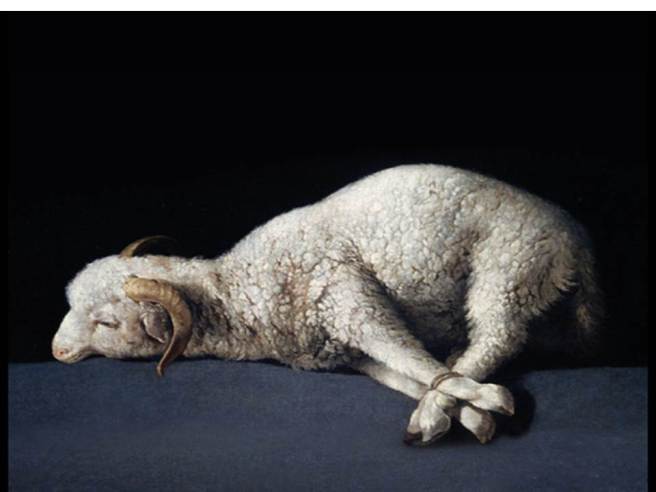
However, God called for a sacrifice from the Israelites which will preclude them from the looming death. The sacrifice was the killing of a lamb, without blemish and male; smearing its blood on the doorposts. “The blood shall be a sign for you, on the houses where you are. And when I see the blood, I will pass over you, and no plague will befall you to destroy you, when I strike the land of Egypt.” (Exodus 12:13).
Christ The Passover Lamb
John the Baptist in John 1:29 announced Christ as “the Lamb of God, who takes away the sin of the world!” In Revelation 13:8, Christ is the Lamb of God slain from the foundation of the earth. And in Isaiah 53:7, he is the Lamb led to the slaughter. In 1 Corinthians 5:7 Christ, our Passover lamb, has been sacrificed.
This Lamb, we look back to Exodus and without a doubt see the lamb that was sacrificed as a type of Christ. The concept of the Lamb of God is central to the beliefs of Christianity. Indeed we trace this throughout the Bible. The sacrificial system of Old Testament worship revolved around the sacrifice of bulls and goats that temporarily cleanses sin. But Jesus Christ is the lamb of God who offered himself up as a sacrifice for sin once and for all (Hebrews 10:1-12). The Passover lamb sacrificed points to Christ The Lamb of God crucified.
Also, the lamb crucified on the Passover was a form of substitution for the Hebrews in Egypt. The lamb was crucified in place of the death of male firstborn children in the homes of the Jews. Jesus Christ, in the same way, died in the place of sinners. He died a substitutionary death for our salvation (Isaiah 53:5; Rom 4:24-25; 2 Cor. 5:21; 1 Pet.2:24).
Yet another compelling evidence that Christ is the Passover lamb in Exodus 12 is that he was crucified on the night of the Passover (John 13:1;18:28;39; 19:14). This is significant as it fully points us back to Exodus 12.
A Lamb Without Blemish
The Israelites couldn’t offer just any lamb. The lamb required was to be without blemish; that is, a lamb without any form of defects. A lamb without blemish can be viewed as a perfect sacrifice and this perfectly fits Christ. He is the sacrifice without blemish. There was no fault found in him yet he was crucified. In relation to the perfection of the lamb for the Passover sacrifice, it was to be kept and examined for four days before the sacrifice. This examination was for the purpose of ensuring indeed the animal has no blemish.
And this beautifully paints a picture of how Christ was crucified. When he was picked up, he was cross-examined and indeed exonerated of any crime. Three times Pilate declared Jesus “not guilty” (John 18:38; 19:4; 19:6). Not only here in John, but in many places in the New Testament, Christ’s perfection is taught. Luke records the reaction of the centurion after Christ has been crucified saying “Certainly this man was innocent”. In the double imputation of 2 Corinthians 5:21, Christ, who knew no sin took our sin upon himself and passed on to us his righteousness. Hebrews 4:15 describes Christ as One who was tempted just as we “yet without sin.” And the apostle Peter in 1 Peter 1:18-19 describes our salvation as purchased with the blood of the Lamb without spot.
These facts reveal the harmony in Scripture. Scripture interprets Scripture and never contradicts itself. We can never, throughout the New Testament see Jesus Christ tainted with sin. If he had sin, then he is disqualified to die in our place. He is the lamb without blemish. Hallelujah!
A Male Lamb
We may easily gloss over this, but we shouldn’t. The instruction was clear in Exodus 12:5. The lamb was to be a male. And Christ was male. In Luke 2:21-23, we read that Jesus was circumcised. Of course, it is males who are circumcised.
Jesus Instituted The Lord’s Supper
God instituted a festival to commemorate the events of Exodus 12 popularly called the Passover (Exodus 12:14;24-27). The Passover marks the story of the angel of death passing over Israel but killing all the firstborn males of the Egyptians including beasts. Before Christ was crucified, he also established the Lord’s Supper which he indicates is for the remembrance of his death. The blood that was shed on the Passover night is the blood of Christ that has redeemed us from the wrath of God (Luke 22:15-20).
Lamb of God so pure and spotless,
Lamb of God for sinners slain.
Thy shed blood has wrought redemption,
Cleansing us from every stain.
Lamb redeeming, Lamb redeeming,
Bearing all our sins away,
Bearing all our sins away!¹
Notes

 Grace and Truth