
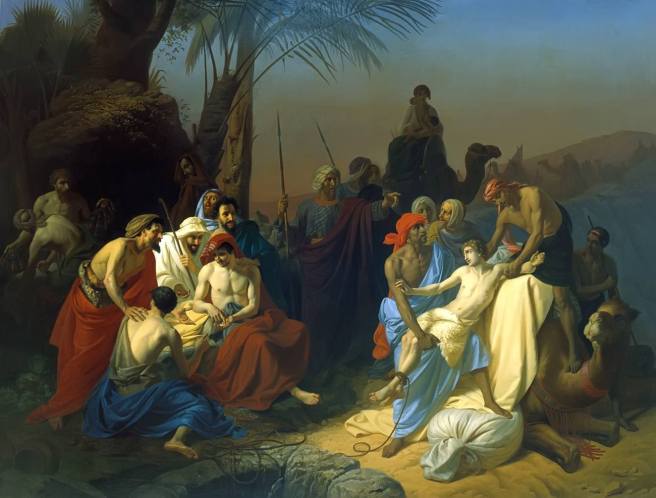
The story of Joseph, found in Genesis 37-50 begins with a genealogy: “Jacob lived in the land of his father’s sojourning, in the land of canaan. These are the generations of Jacob. Joseph, being seventeen years old, was pasturing the flock with his brothers.” (vv.1-2). The text is an unusual beginning to a genealogy. If you study Scripture, genealogies often begin with fathers begetting children. “Adam begat…Noah begat… Abraham begat…” But this genealogy introduces us to a seventeen-year-old boy. Joseph here, therefore, becomes the main character. At this point in Genesis, the spotlight is on Joseph. His story takes preeminence from Genesis Chapter 37 to Chapter 50. And there is a profound truth to consider in the narrative: the unfolding fulfilment of a promise made to Abraham in Genesis 15:13-14.
13 Then the LORD said to Abram, “Know for certain that your offspring will be sojourners in a land that is not theirs and will be servants there, and they will be afflicted for s four hundred years. 14But I will bring judgment on the nation that they serve, and afterward u they shall come out with great possessions.
In the text are two things: Israel going to Egypt as slaves and their exodus from Egypt. All these is part of the bigger picture of God’s redemptive plan of redeeming a people for Himself. Now we know it was through Joseph Israel went to Egypt. I will not here recount the story of Joseph on the assumption it is a well-known story. Rather, I will get into the article examining how Joseph is a type of Christ. But before that, let me answer the question of what is a type? in case you are asking.
The subject of types is studied under the bigger umbrella of typology.
Typology is a method of biblical interpretation whereby an element found in the Old Testament is seen to prefigure one found in the New Testament. The initial one is called the type and the fulfillment is designated the antitype. Either type or antitype may be a person, thing, or event, but often the type is messianic and frequently related to the idea of salvation.¹
How then is Joseph a type of Christ? In verse 3, we see the first element pointing to Joseph as a type of Christ. He was loved by his father. Now just as Joseph was loved by his father, Christ is One who is loved by the Father (John 17:26; Matthew 3:17). Jacob’s love for Joseph produced hatred from his brothers (vv. 4-5;8). And to make matters worse, he started having dreams which appear to put him above his brothers. They didn’t only hate him. But rejected any idea of him being a ruler over them: “His brothers said to him, “Are you indeed to reign over us? Or are you indeed to rule over us?” So they hated him even more for his dreams and for his words.”(v.8).
We see these events pointing to Christ in a unique way. He was also hated by his brothers and they rejected his ministry (John 7:5; 15:24, 1:11). Again, just as the brothers conspired against Joseph and sold him into slavery, Jesus Christ was conspired against and crucified by his own brethren—the Jews.
Another point of reference to Jesus Christ in the narrative is that Joseph was sent to his brothers (vv.13-17). He was sent by his father to seek the welfare of his brothers in the field. He went seeking them just like Christ came seeking the lost sheep of Israel (Matthew 15:24, Jeremiah 50:6). The ministry of Christ was to also seek out for God’s lost children in sin. The story of Joseph was also one of suffering and injustice. He was sold out and ended up in prison for a crime he didn’t commit. But in all of these, we know from the narrative that Joseph’s suffering was predetermined by God: “…you meant evil against me, but God meant it for good, to bring it about that many people should be kept alive, as they are today.” (v.20). Here we see another element where Joseph serves as a type. Just like Joseph, Christ’s suffering was predetermined and ordained by God (John 3:16; Acts 2:22-23; 7:52). Christ’s suffering was prophesied. He was the suffering servant in Isaiah 53.
One of the prominent moments in the Joseph narrative was his temptation by Potiphar’s wife (vv. 7-12). And what we remember most about this temptation is Joseph’s moral character. Like Christ, he was tempted but didn’t sin. “For we do not have a high priest who is unable to sympathize with our weaknesses, but one who in every respect has been tempted as we are, yet without sin.” (Hebrews 4:15).
Finally, Joseph was raised to preserve a generation. He was a saviour to his people. In Genesis 50:20, he identifies his sojourning to Egypt as a life-saving event: “As for you, you meant evil against me, but God meant it for good, to bring it about that many people should be kept alive, as they are today.” Also, though they betrayed and sold him out, Joseph forgave his brothers not holding anything against them.
Jesus Christ is the Saviour sent into the world to save his people from their sins: “She will bear a son, and you shall call his name Jesus, for he will save his people from their sins.” (Matthew 1:21). And when he was crucified, he pleaded forgiveness for those who crucified him (Luke 23:24).
Next week God willing, I will consider another type of Christ in the Old Testament: Moses. Thanks for reading
Notes
Discover more from Grace and Truth
Subscribe to get the latest posts sent to your email.

 Grace and Truth
Thanks Ps Enoch. Just a small typo on Genesis 50 reference. Check.
The promise of the messiah as antitype to that of Joseph in the OT must be connected and explained well. It may be interpreted as part of Gen 15 prophecy by God and the redemption plan for mankind starting after the fall in Gen 3.
LikeLiked by 1 person
Thank you very much Edwin for making the time to read and notifying me of the correction for the typo. I have corrected it.
About linking the promise of the messiah as antitype and Joseph, I did mention Genesis 15. I also treated Genesis 3 in earlier articles pointing to Christ as the seed of the woman promised who will crush the head of the serpent.
That said, I will look at the whole article again and work on places where clarity is missing. I am grateful
LikeLike
Interesting connections! Thanks for sharing.
LikeLike
Glory to God for the harmony in his word. And I an grateful you made the time to read and leave a comment.
LikeLiked by 1 person