June 2026. We have halved 2026. Let’s begin with a question. If you are given the opportunity to scan your whole existence how will you describe it? fruitful, productive,
Successful, wasteful, failure, regrets, joys or sadness? Perhaps your situation is unique. It has no vocabularies to capture it. Whatever the case, you may come to a desirable or undesirable conclusion.
Let me push another question.
How will you describe your whole existence in relation to God? Has your life been God glorifying? One ancient sage has said “an unexamined life is not worth living”. This means at every point in our lives, we must be able to examine ourselves whether we are moving in the right direction (2 Corinthians 13: 5).
In the opening Chapters of Ecclesiastes, Solomon opens up for us his reflections on life. He begins by identifying the futility of life (Ecclesiastes 1:1-3;14;2:11) and at the end, he draws a conclusion in Chapter 12.
Ecclesiastes contains reflections of an old man, the “Preacher” as he considered the question of meaning in life. He looked back and saw the futility (“vanity”) of chasing after even the good things can offer, including wisdom, work, pleasure, and wealth. Even if such things are satisfying for a time, death is certain to end the satisfaction.¹
Life is a precious thing to waste because we live only once. And if your life is wasted, it is gone. You can’t reclaim it.
How can we then live not wasting our lives?
Remember Your Creator
“Remember also your Creator in the days of your youth…” This is the opening words of Ecclesiastes 12:1. And one of the first things taught in the text is that there is a Creator. The first book in the Bible, Genesis opens with the words “In the beginning, God created the heaven and the earth” (1:1). It goes on to further tell us “… God created man in his own image, in the image of God he created him, male and female created he them” (Genesis 1:27). This is the most important understanding we need to come to in life that there is a Creator. It brings focus to us. We begin asking the right questions. If there is a Creator, why did he create me? What’s the purpose of my life?
In answering the purpose of human existence, the Westminster Shorter Catechism opens with the first question: What is the Chief end of man?
That question seeks to answer the reason for existence. Why am I on earth, what is the purpose of my life? The catechism answers that “Man’s chief end is to glorify God and to enjoy him forever” This, glorifying God, is the reason for our existence. Unfortunately, many people seek meaning and purpose in the wrong places; in material possessions, pleasures and sinful indulgence without any regard for God in their lives.
When Ecclesiastes says “Remember your Creator” it means that we can forget our Creator. We can live our lives without any thought of God. And naturally, that’s what all human beings do. We come into the world as sinners and will have nothing to do with God. We don’t love him. We don’t want him having control over our lives. We want to be our own boss, so we push God to the background.
How will you describe your life? Are you someone seeking God or running away from him? You don’t like the idea of God controlling your life? Solomon made some conclusions in his deliberations: The end of the matter; all has been said. Fear God and keep his commandments, for this is the whole duty of man.
There are two thoughts here: Fear God and Keep His Commandments
Fear God and Keep His Commands
God is a Holy God. We are sinful people. Therefore we must fear God. Some people argue God is a loving God so it is not right to speak about fearing God. Well, it is here. The Bible says it: Fear God. What does it mean to fear God? Fear God and Keep his commandment appear in the same sentence. This means the fear of God has something to do with obedience. The fear of God is keeping away from sin. The fear of God is living a holy life and shunning sin. But because God is Holy, and we are sinners, we cannot do this by ourselves. Naturally, our sin has separated us from God and the only way we can even begin to obey him is by faith in Jesus Christ.
This is a very fundamental Christian teaching. Nobody can have a relationship with God who has not believed in Jesus Christ. It is only Jesus Christ who can bring us close to God. He died to save sinners so that anyone who will believe in him and repent from their sin will be saved.
Redeem The Times
In Ecclesiastes 12:1, there are three periods in our lives that are compared: “the days of your youth… the evil days…the years” These three are speaking about three different phases of life. The first phase is clear, it is the days of your youth, a period of energy, strength and opportunities. They are the best days when the foundation of life is laid. They are also the time we live our lives to enjoy all the pleasures of life
Rejoice, O young man, in your youth, and let your heart cheer you in the days of your youth. Walk in the ways of your heart and the sight of your eyes. But know that for all these things God will bring you into judgment (Ecclesiastes 11:9).
Solomon here is saying enjoy your life, enjoy your freedoms, but remember you will face judgement one day. The point is that the youthful days offers us all the opportunities of life. And we are to take great care of how we live during this time of our lives. Because every bad decision of youth has future ramifications. To redeem the times is to make good use of every single waking day. We should live our lives everyday as if it is the last. Paul writing to the Ephesians tells them and by extension us: Look carefully then how you walk, not as unwise but as wise, making the best use of the time, because the days are evil. Therefore do not be foolish, but understand what the will of the Lord is (Ephesians 5:15-17).
Our days on earth is brief and whatever ought to be done, must be done now.
Tomorrow is not guaranteed, the next hour and minute is not. Let’s make the best of our times in living for God: “Remember also your Creator in the days of your youth, before the evil days comes….”
A Coming Evil Day
Why must you remember your Creator in your youth? Because there is an “evil day” coming. What is this evil days. It is describes old age. And Solomon uses certain metaphors to describe this phase of life. This is the phase opportunities are gone. You are weak and probably will be dependent on others.
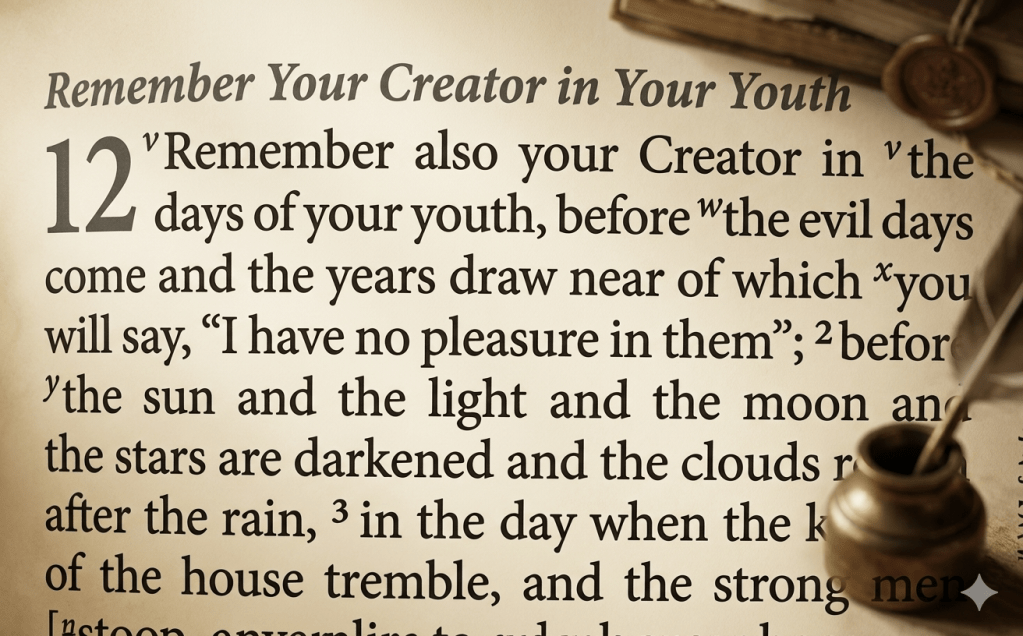
2before the sun and the light and the moon and the stars are darkened and the clouds return after the rain, 3in the day when the keepers of the house[legs and hands] tremble, and the strong men are bent[bent over posture], and the grinders[teeth] cease because they are few, and those who look through the windows are dimmed[eyes]
And most often, if one has not lived their lives well, this period comes with regret: regrets of wasted opportunities and inactions: “and the years draw near which you will say, “I have no pleasure in them”. This is a language of regret. It is possible if you begin looking back as an individual, you may have some regrets. I have regrets. If you have no regrets then you must be the most wonderful person on earth.
How are you living your life now? In 5 or 10 or 20 years in future, will you be happy with how you are living now? And it is important the Bible says we should remember our Creator in the days of our youth. These are the best days and we should use them in service to God.
Remember The Judgement Day
The years drawing near is also a marker of coming judgement. Everyone will one day die. That’s the final destination we are all heading. In the next 100 years, it is unlikely anyone reading this article in 2026 will be alive.
before the silver cord is snapped, or the golden bowl is broken, or the pitcher is i shattered at the fountain, or the wheel broken at the cistern, and the dust returns to the earth as it was, and the spirit returns to God who gave it (vv.6-8)
This is a picture of death and it is the final day of our human existence. But life doesn’t end after death. THe Bible speaks of an eternal destination for every living soul when they die. That destination will be either eternal life of eternal damnation.
Now after death, there is judgement that will determine our eternal destinies (Hebrews 9:27). We will all one day stand in judgement before God to answer for how we lived our lives: “For God will bring every deed into judgment, with every secret thing, whether good or evil.” (v.14).
It is common that peoole think of judgement as weighing their good deeds against their bad. And when they have done so much good than bad, then they will be saved. No, the Bible knows of no such thing. Indeed no human being will be able to stand the judgement of God on account of their good works. No good work is good enough. God is Hly, and all of our goodness will not match his holiness. God’s judgement will not be weighing good against bad. God’s judgement will be based on our faith and trust in Jesus Christ. But for Christ, no one will survive the judgement of God (Ephesians 2:8-9).
The only way you and I will pass the judgement of God and be reconciled to him in all of eternity is faith in Christ. This is the opportunity to get right with God. If you have lived all your life without regard to God, this is an opportunity where God reaches out to you. Put your faith in CHrist and repent from your sins. Else, a great judgement awaits you—-a judgement of eternal torment in hell and everlasting separation from the love and presence of God in eternity.
You have the opportunity now.
Receive Christ. Believe in Christ. Put your trust in Jesus for the salvation of your soul and repent, turn away from your sin and rebellion to God. Amen
Notes
1 ESV Study Bible. Wheaton, IL: Crossway, 2008. Introduction to Ecclesiastes
Discover more from Grace and Truth
Subscribe to get the latest posts sent to your email.


